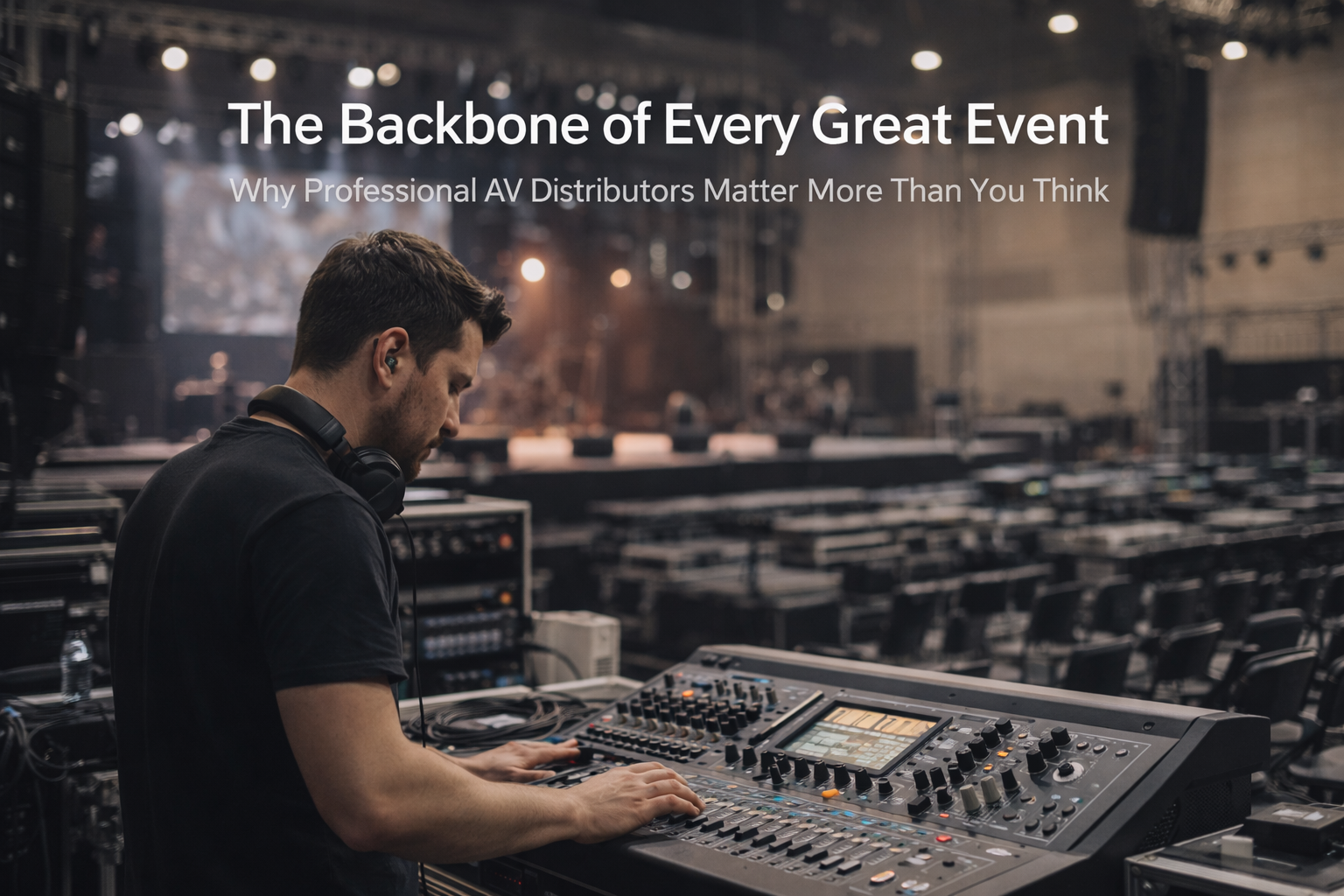
When people think about concerts, conferences, weddings, corporate launches, or live performances, they usually imagine the performers, the stage design, or the audience experience. Rarely do they think about the complex technical ecosystem working behind the scenes to make those moments possible. Yet every successful event relies on one critical foundation: reliable professional audio-visual equipment and the companies that supply it.
According to public business profiles, MSL operates with the goal of bringing professional audio solutions to clients across India and serves installers, event companies, studios, musicians, and retailers.
This type of distribution model is essential in a country where the live-event market, corporate AV installations, and entertainment sectors are all expanding at the same time.
The Hidden Complexity Behind “Simple” Sound
To most people sitting in an audience, sound appears effortless. A speaker walks onto the stage, speaks into a microphone, and their voice fills the room. Music plays, transitions are seamless, and everything feels natural. When it works well, it feels almost invisible — as if it simply happens.
But that apparent simplicity is the result of complex engineering, technical planning, and real-time problem solving.
Professional audio is not just about making things louder. It is about delivering controlled, intelligible, consistent sound under constantly changing conditions. What the audience hears is the final output of a system that has been carefully designed, calibrated, and monitored.
At its core, a professional sound system must provide even coverage across a space. In small rooms, this may seem straightforward. In large venues — conference halls, outdoor arenas, churches, theaters — it becomes exponentially more complicated. Sound behaves differently depending on distance, surface materials, ceiling height, and room geometry. Reflections, echoes, and frequency buildup can quickly reduce clarity if not managed properly.
An effective system ensures that the person in the front row and the person in the last row experience similar intelligibility and tonal balance. Achieving that requires precise speaker placement, acoustic prediction modeling, delay alignment, and frequency tuning. It is physics, not guesswork.
Acoustics further complicate matters. No two venues behave the same way. A room filled with glass and concrete reflects high frequencies aggressively. A carpeted ballroom absorbs sound differently. Outdoor environments eliminate reflections but introduce wind, environmental noise, and dispersion challenges. Each environment demands a tailored solution.
Audio professionals must evaluate the space before an event even begins. They consider reverberation time, room modes, absorption characteristics, and audience density. A venue sounds different when empty compared to when filled with people. Human bodies absorb sound, particularly mid and high frequencies. A system tuned during rehearsal may require adjustment once the room fills.
Beyond acoustics, modern events demand integration. Sound systems rarely operate in isolation. They must communicate with lighting consoles, video playback systems, live streaming feeds, stage management software, and sometimes broadcast networks. Synchronization is critical. A slight delay between audio and video can disrupt audience perception instantly.
This is where experienced distributors become essential—not just as sellers of products, but as technical advisors who understand how different components work together.
Why Distribution Is Critical in the AV Industry
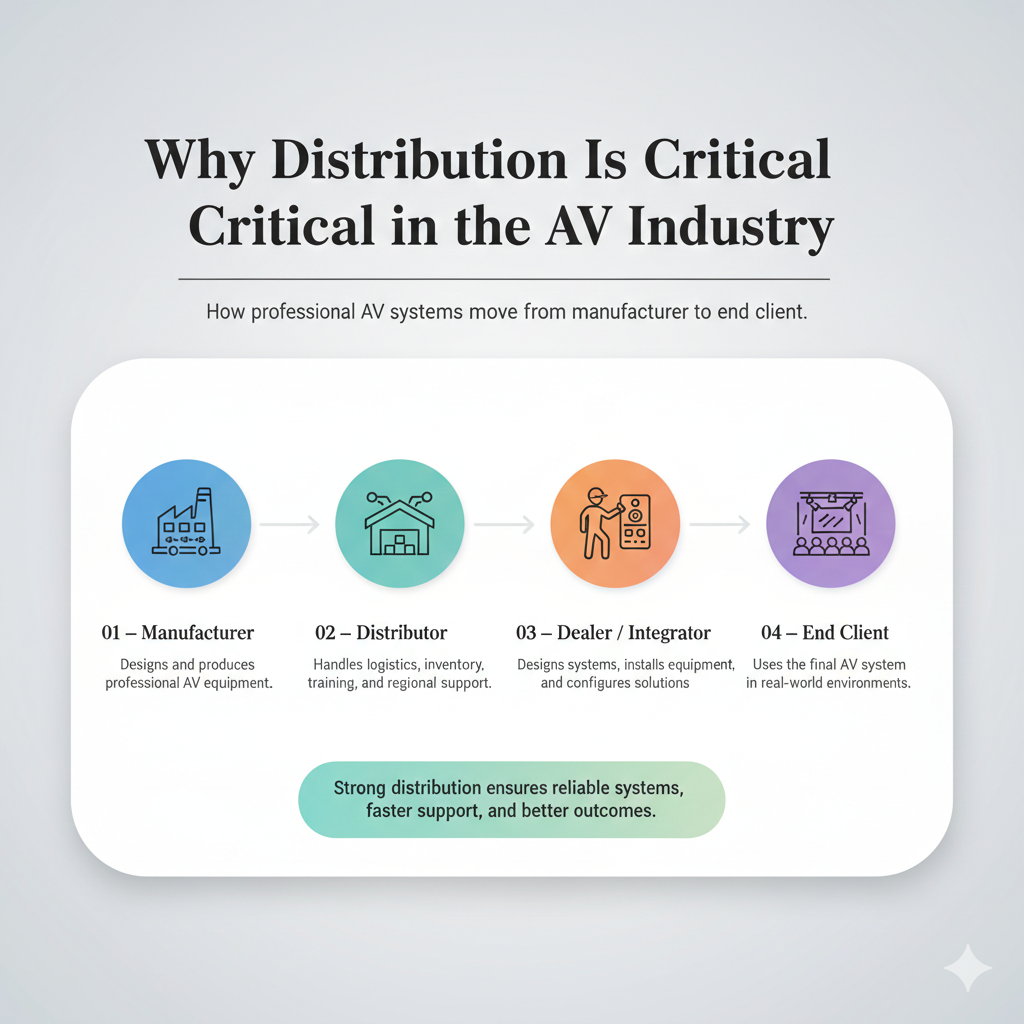
In the professional AV sector, products rarely move directly from a manufacturer to the end user. Unlike consumer electronics — where customers can purchase directly from a retail store or online platform — professional audiovisual systems operate within a structured supply chain.
The typical flow looks like this:
Manufacturer → Distributor → Dealer / Integrator → End Client
This structure is not accidental. It exists because professional AV systems are technical, application-driven, and often customized to specific environments. Each layer in the chain plays a distinct and necessary role.
Manufacturers focus on product development, engineering, and large-scale production. Their expertise lies in designing loudspeakers, DSP processors, microphones, LED walls, control systems, and other specialized equipment. However, they are not positioned to manage local logistics, provide region-specific technical support, or train every installer in every market.
This is where distribution becomes essential.
A professional AV distributor serves as the operational and technical bridge between global brands and local system integrators. Their role extends far beyond simply moving boxes from warehouse to dealer.
First, distributors stabilize supply chains. Professional AV projects often operate under strict deadlines. A delayed amplifier, missing mounting bracket, or unavailable cable interface can halt an installation. Distributors maintain local inventory, forecast demand, and manage import logistics. This reduces lead times and protects integrators from international shipping delays or customs complications.
Second, distributors provide structured product training. Professional AV equipment is rarely plug-and-play. Digital signal processors require configuration. Networked audio systems require IP knowledge. Control platforms demand programming skills. Without proper education, even high-end equipment cannot perform as intended.
A strong distributor invests in workshops, certification programs, demo facilities, and hands-on technical sessions. This empowers dealers and installers to design and deploy systems correctly, which ultimately protects the manufacturer’s brand reputation.
Without this layer, many installers and event companies would struggle to source equipment quickly or get the technical support they need.
The Indian AV Market: A Rapidly Expanding Landscape
India’s professional AV industry has evolved dramatically over the past decade. What was once a niche technical segment serving limited event and broadcast needs has expanded into a dynamic, multi-sector ecosystem. Growth has been fueled by economic development, digital transformation, rising production standards, and a cultural shift toward experiential communication.
Today, professional audio-visual solutions are no longer optional enhancements — they are central to how organizations communicate, celebrate, educate, and broadcast.
India’s professional AV sector has grown significantly over the last decade. Several factors are driving this expansion:
1. Corporate Event Growth
India’s corporate sector has scaled rapidly across technology, finance, pharmaceuticals, manufacturing, and startups. With this growth comes increased demand for structured communication — both internal and external.
Companies now host:
-
Product launches with immersive stage design
-
Annual conferences with multi-city live streaming
-
Hybrid meetings integrating in-person and remote audiences
-
Brand activations and experiential marketing events
These events require more than basic sound reinforcement. They demand synchronized audio, LED walls, projection mapping, lighting control, live switching, and streaming integration.
Clarity of speech, seamless transitions, and broadcast-quality production standards are now expected — not exceptional. As organizations compete for attention in crowded markets, production quality directly impacts brand perception.
This has significantly expanded the need for skilled integrators, rental providers, and system designers.
Companies are hosting more product launches, conferences, and hybrid events than ever before.
2. Wedding Industry Scale
India’s wedding industry is one of the largest in the world, and it has transformed into a high-production spectacle segment.
Modern weddings frequently include:
-
Concert-style sound systems
-
Large-format LED screens
-
Intelligent lighting rigs
-
Live bands and celebrity performances
-
Themed stage productions
Multi-day celebrations often take place in destination venues, requiring complex temporary AV infrastructure. This has driven growth in the live event rental market, particularly for line array systems, digital mixing consoles, wireless microphones, stage lighting systems, and power distribution setups.
Large-scale weddings with stage shows, live music, and elaborate lighting have become common.
The Role of Experience in Equipment Selection
One of the biggest challenges in professional AV is choosing the right equipment for each project.
Two speakers might look similar on paper, but:
-
One may perform better for speech.
-
Another may be optimized for music.
-
One may handle outdoor environments.
-
Another may be better suited for indoor acoustics.
Distributors with years of experience help installers and clients avoid costly mistakes.
For example:
-
Choosing underpowered speakers can ruin an event.
-
Over-specifying equipment increases costs unnecessarily.
-
Mismatched components can cause technical failures.
With over two decades of industry experience, companies like MSL are positioned to guide buyers toward solutions that balance performance, reliability, and budget.
The Difference Between Retail and Professional Audio
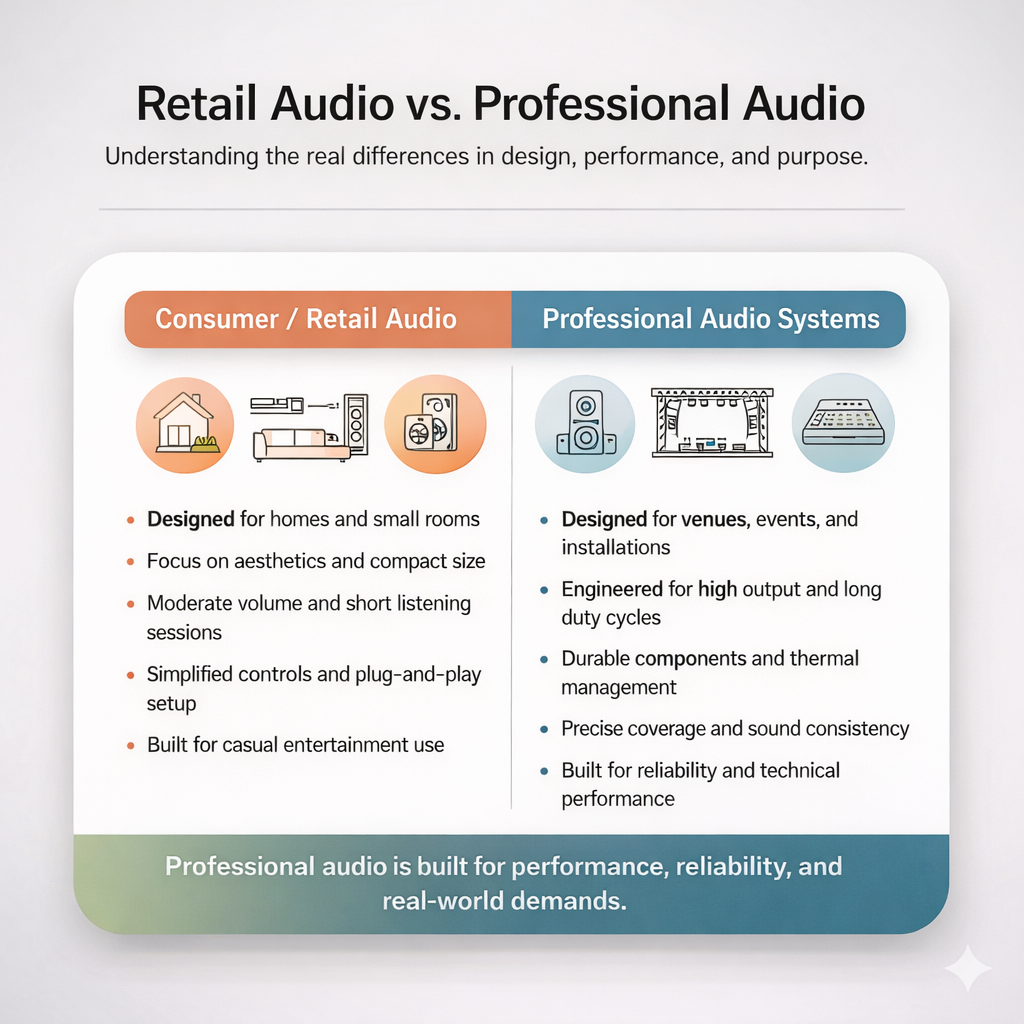
It is often assumed that professional audio equipment is simply a larger and more powerful version of consumer sound systems. This view overlooks the fundamental differences in engineering intent, operational environment, and performance expectations that separate the two categories.
Consumer audio is designed primarily for residential settings. Its development prioritizes visual appeal, compact form factors, and ease of use. These systems are built to operate at moderate listening levels within confined spaces such as living rooms or bedrooms. The tuning focuses on delivering a pleasing tonal balance for music and entertainment rather than maximizing output consistency across large areas. Components such as amplifiers, drivers, and enclosures are engineered with cost efficiency and aesthetics in mind. Thermal management and structural durability are sufficient for intermittent household use, but they are not intended for sustained high sound pressure levels or demanding duty cycles.
Professional audio systems are engineered for environments where reliability and performance are critical. These include auditoriums, conference halls, houses of worship, stadiums, and live event venues. In such settings, equipment must deliver consistent coverage, speech intelligibility, and high output over extended periods. The design emphasizes robust cabinet construction, higher power handling, advanced signal processing, and precise control of dispersion patterns. Installation typically involves acoustic assessment, impedance calculations, rigging standards, and digital signal processor configuration. Proper calibration is essential to achieve uniform sound distribution and prevent system failure.
Because professional audio systems require technical planning, integration expertise, and ongoing support, they are distributed through specialized channels rather than general electronics retailers. The distinction is not merely about size or volume; it reflects entirely different performance objectives, engineering standards, and operational demands..
The Digital Presence of Modern AV Companies
In today’s market, even traditional equipment distributors must maintain strong digital platforms.
Clients expect:
-
Online product catalogs
-
Technical specifications
-
Quick contact options
-
Clear company positioning
A professionally structured website often serves as the initial interaction point between a company and its prospective clients. It shapes perception, communicates capability, and establishes credibility before any direct conversation takes place.
Across industries, organizations are prioritizing digital environments that are intuitive, efficient, and clearly organized. Accessible product information, streamlined communication channels, and user-focused design have become operational necessities rather than enhancements.
In a market where first impressions are frequently formed online, digital infrastructure is no longer a supporting element—it is a central component of business strategy.
Conclusion: The Quiet Force Behind Every Great Experience
Behind every concert, corporate summit, worship service, product launch, or live broadcast is a technical ecosystem operating with precision. While audiences see performers, speakers, and visuals, the infrastructure enabling those moments remains largely invisible.
Within that ecosystem, distributors play a structurally critical role.
They are not merely intermediaries moving equipment from manufacturer to buyer. They function as technical bridges, logistical coordinators, risk mitigators, and knowledge hubs.
Their Role in the AV Value Chain
Distributors:
- Connect global technology with local professionals
They translate international manufacturing standards into regionally deployable solutions. - Provide technical expertise
From system design guidance to product training, they ensure integrators deploy equipment correctly and efficiently. - Ensure reliable supply chains
Timely availability of inventory, spare parts, and warranty support reduces operational risk for partners. - Support installers and event companies
Pre-sales consultation, post-installation troubleshooting, and field-level technical assistance strengthen project execution. - Enable creative execution
By providing the right tools and knowledge, they help transform conceptual ideas into technically sound, scalable systems.
In a market like India—where demand for professional AV is expanding across corporate, hospitality, worship, education, and live entertainment sectors—the distributor’s role becomes even more strategic.
They absorb complexity so that system integrators, rental companies, and event producers can focus on delivery and creativity.
Companies such as MSL Technologies exemplify this backbone function. Through technical depth, global brand partnerships, structured training, and consistent supply reliability, they help sustain the infrastructure behind India’s professional audio and AV growth.
Great experiences rarely happen by accident. They are engineered, supported, and delivered through coordinated effort.
And while distributors may not stand on stage or appear on screen, their contribution is embedded in every successful show, seamless conference, and immersive installation.